Digital Daily Subsistence Allowance Management System
Customer Overview
The customer operates across multiple African countries and supports entrepreneurs through structured business development programmes. These programmes include mentorship, training, educational tools, and support for compliance and funding access.
Programme delivery often takes place in person across multiple regions, including remote locations. Participants may travel long distances to attend training sessions and receive Daily Subsistence Allowances to cover transport, food, and accommodation.
This operating model requires reliable, transparent, and scalable systems that can support programme administration, attendance verification, payment control, auditability, and reporting across distributed environments.
Challenges
The customer’s existing allowance process relied on physical cash distribution at training sites. This created material operational, governance, financial, and security risks.
Field staff were responsible for transporting and distributing cash across training venues, often in remote locations and across multiple countries. This operating model created several challenges:
- Physical cash exposure, including theft, loss, fraud, and human error.
- Limited operational visibility over payment status and allowance distribution.
- Weak auditability between attendance records and actual payments.
- Manual reconciliation between paper attendance registers, cash balances, and payment records.
- Delayed payments, negatively affecting participant trust and experience.
- Difficulty scaling programme delivery across additional countries without duplicating manual cash logistics.
- Increased operational burden for field teams, finance teams, and programme administrators.
- Limited ability to support centralized oversight, reporting, and governance across regions.
The customer needed a governed AWS operating model that could support a secure digital disbursement platform with centralized control, operational visibility, backup protection, auditability, and scalable programme delivery.
Cloud Operations Capabilities Delivered
Tati Software delivered a customer-deployed AWS Cloud Operations solution to support the customer’s production digital disbursement workload. The solution replaced manual cash-based operations with a centrally managed AWS-hosted platform designed for operational visibility, controlled access, auditability, backup, monitoring, and scalable programme delivery.
The Cloud Operations capabilities delivered included:
- Centralized AWS account governance using AWS Organizations and AWS Control Tower to support controlled environment management.
- Environment separation across production and non-production environments to support controlled testing, validation, release preparation, and operational stability.
- Centralized billing and account-level visibility through the AWS Organizations account structure.
- Preventive governance controls using Service Control Policies and AWS Control Tower guardrails where applicable.
- Detective governance controls using AWS Config rules and AWS Control Tower detective controls where applicable.
- Centralized compliance visibility using AWS Config aggregation and compliance dashboards where applicable.
- Centralized audit logging using AWS CloudTrail to capture AWS API activity, role assumptions, administrative actions, and infrastructure changes.
- Infrastructure as Code deployment using AWS CloudFormation / AWS CDK patterns to support repeatable provisioning and controlled infrastructure changes.
- Load-balanced production access using AWS traffic-management patterns to improve availability and reduce dependency on a single application entry point.
- Durable operational records using Amazon S3 for attendance records, payment logs, and reporting artefacts.
- Backup and recovery controls using AWS Backup and durable storage patterns to protect operational records and support recovery objectives.
- Secure configuration management using AWS Secrets Manager and controlled access patterns.
- Centralized monitoring and observability using Amazon CloudWatch, Datadog-supported logs, dashboards, metrics, and operational telemetry.
- Incident response and escalation workflows supported by operational logging, triage, remediation tracking, and post-incident review.
- Controlled deployment and change management through staged releases, validation processes, and governed operational support.
- Operational governance and financial control by replacing physical cash handling with a traceable digital workflow.
These capabilities enabled the customer to reduce manual operational risk, improve auditability, reduce reconciliation overhead, strengthen financial control, and scale DSA programme delivery across multiple countries without replicating manual cash logistics.
Centralized AWS Governance and Account Management
Tati Software implemented a centralized AWS operations governance model to support controlled, secure, and repeatable management of the Digital DSA workload.
The environment is managed using AWS Organizations and AWS Control Tower, with workload separation across production and non-production environments. This structure enables centralized governance while maintaining isolation between environments used for live operations, validation, and release preparation.
The centralized governance model supports:
- Account structure and environment separation through AWS Organizations.
- Baseline account governance through AWS Control Tower.
- Preventive controls using Service Control Policies and AWS Control Tower guardrails where applicable.
- Detective controls using AWS Config rules and AWS Control Tower detective controls where applicable.
- Centralized configuration and compliance visibility through AWS Config aggregation.
- Centralized auditability through AWS CloudTrail.
- Centralized security posture review through AWS Security Hub where applicable.
- Centralized billing and account-level cost visibility through AWS Organizations.
- Controlled infrastructure provisioning through Infrastructure as Code.
- Operational monitoring through Amazon CloudWatch and Datadog.
- Structured incident response and remediation workflows.
This ensures that the Digital DSA platform is not operated as an isolated AWS deployment, but as a governed production workload with consistent operational controls for security, auditability, deployment, monitoring, and support.
Proposed Solution and Architecture
Tati Software designed and delivered a secure AWS-hosted digital disbursement platform that replaced manual cash handling with a centralized, auditable, and scalable operational workflow.
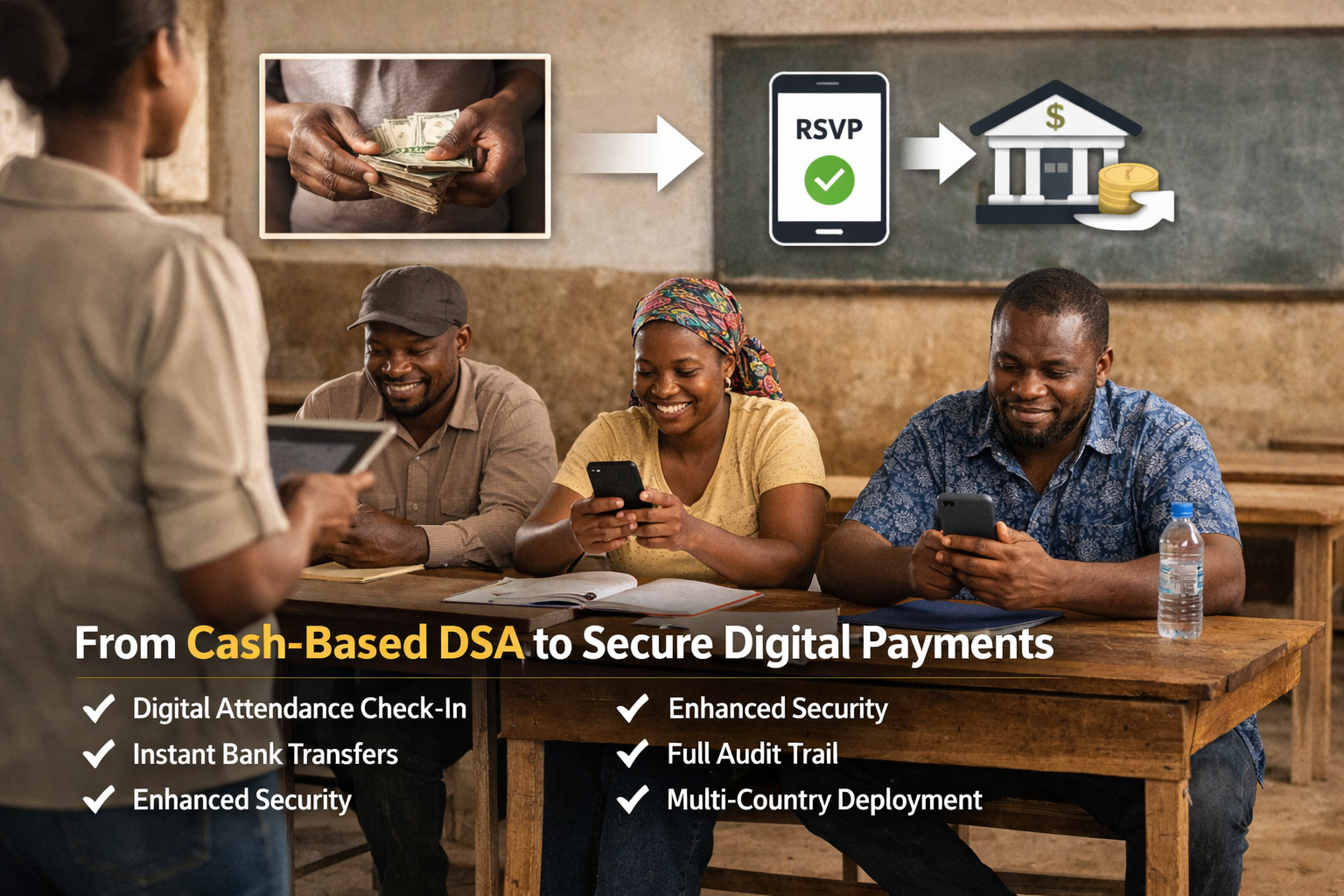
The platform digitises the full Daily Subsistence Allowance lifecycle. Participants can RSVP digitally, confirm attendance, and receive payments through a controlled digital process once attendance is validated. Programme and finance teams gain improved visibility into attendance, payment status, operational records, and reporting outputs.
The production architecture uses AWS services including:
- Amazon EC2 for production application workloads.
- Elastic Load Balancing for resilient traffic distribution.
- Amazon Route 53 for DNS management and reliable access.
- Amazon S3 for attendance records, payment logs, reporting artefacts, and supporting files.
- AWS Backup for policy-driven backup and data protection.
- AWS Secrets Manager for secure configuration and secrets handling.
- Amazon CloudWatch and Datadog for monitoring, dashboards, logs, metrics, and operational investigation.
- AWS CloudTrail for audit logging of AWS API activity and infrastructure changes.
- AWS Config for resource configuration visibility and compliance tracking where applicable.
- Amazon VPC for secure network isolation and controlled communication between platform components.
- Infrastructure as Code using AWS CloudFormation / AWS CDK deployment patterns.
The architecture supports controlled deployment, operational monitoring, backup and recovery, secure access, and scalable rollout across multiple programme regions.
Operational Workflow Transformation
Before the implementation, the customer relied on field staff, paper-based attendance, physical cash distribution, and manual reconciliation. This made it difficult to maintain consistent governance across multiple training locations and countries.
Tati Software transformed the operating model by digitising the full workflow:
- Participants RSVP digitally.
- Attendance is confirmed through the platform.
- Payment workflows are triggered based on confirmed attendance.
- Attendance and payment records are stored digitally.
- Programme and finance teams access operational records and reporting outputs.
- Backup, monitoring, logging, and support processes protect the production environment.
This created a traceable operating model that reduces manual dependency, improves governance, and supports scalable programme delivery.
Monitoring, Logging, and Incident Response
Tati Software implemented operational observability and incident response processes to support the production DSA workload.
Monitoring and logging are supported through Amazon CloudWatch, Datadog, AWS CloudTrail, and structured service logs. These tools provide visibility into system health, application behaviour, infrastructure events, API activity, and operational issues.
When incidents occur, Tati Software follows a structured operational process:
- Intake and evidence capture.
- Initial triage by operations or support teams.
- Escalation to technical teams where required.
- Log-based investigation using application, infrastructure, and AWS telemetry.
- Remediation tracking for confirmed defects or engineering changes.
- Controlled release through development, staging, validation, and production deployment.
- Closure, documentation, and post-incident review.
This operational model ensures that production issues are handled through controlled procedures rather than ad hoc intervention.
Metrics for Success
KPI 1: Reduction in Cash-Handling Risk
Baseline:
Before implementation, DDSA payments were distributed manually using physical cash at training sites. This meant 100% of allowance disbursements were exposed to cash-handling risks such as theft, fraud, loss, manual error, and reconciliation delays.
Target:
Eliminate physical cash handling for platform-managed DDSA disbursement workflows.
Measured Result:
Physical cash handling for platform-managed DDSA workflows was reduced from 100% to 0%, as allowance disbursement processes moved from manual cash distribution to digital attendance-to-payment workflows.
Measurement Method:
Comparison of pre-implementation cash-based disbursement records and field processes against post-implementation digital attendance confirmation and payment workflow records.
Business Impact:
The customer reduced financial exposure, improved operational control, strengthened auditability, and removed a major security risk from programme delivery.
KPI 2: Reconciliation Efficiency / Attendance-to-Payment Accuracy
Baseline:
Before implementation, attendance verification was paper-based and manually reconciled against payment records. Routine reconciliation could take an estimated 2–3 working days per programme cohort, depending on location, participant volume, and exception handling.
Target:
Reduce reconciliation turnaround and improve attendance-to-payment traceability through digital attendance confirmation and centralized payment records.
Measured Result:
Routine reconciliation turnaround was reduced from 2–3 working days to same-day or under 1 working day for standard programme cohorts after digital attendance and payment records were introduced.
Measurement Method:
Comparison of pre-implementation manual reconciliation timelines, attendance mismatch records, and reporting cycles against post-implementation digital attendance-to-payment workflow records.
Business Impact:
Finance and programme teams gained faster reporting, stronger traceability, fewer manual reconciliation steps, and improved audit readiness.
Outcomes
The digital DDSA platform improved operational governance, reduced financial and security risk, strengthened payout traceability, and enabled the customer to scale programme delivery without expanding manual cash logistics. It established a reliable AWS foundation for multi-country operations and created a repeatable pattern for future programme rollouts.
Lessons Learned
The engagement reinforced the importance of designing for distributed operating environments, intermittent connectivity, and simple field execution. Tati Software strengthened its approach to segmented networking, backup management, secure configuration, operational monitoring, and programme-support workflows for future customers operating across remote or multi-country environments.
Let's build your success story.
Talk to us about how we can help your business grow with technology.