

Why Adaptability Is Becoming the Most Valuable Workplace Skill
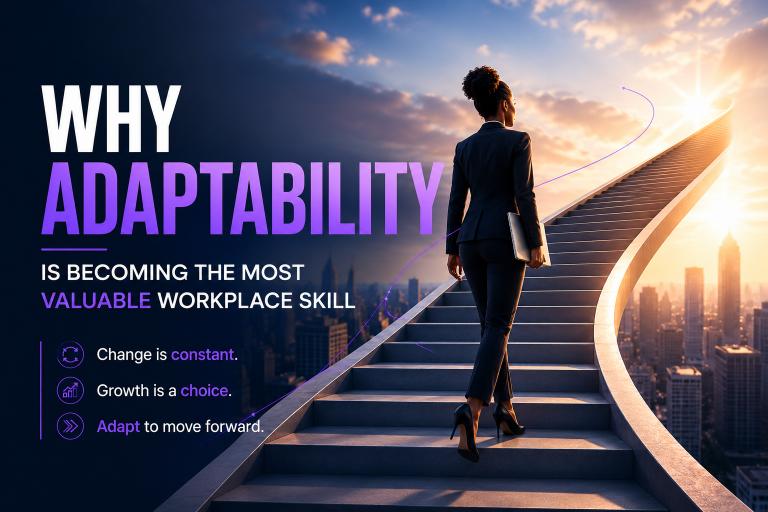
The Only Constant Is Change
If there is one thing today's workplace has taught us, it is that change is no longer an occasional disruption—it has become the norm. New technologies emerge almost daily, industries evolve faster than ever before, and businesses are continuously adjusting to new customer expectations, economic pressures, and ways of working. Whether it's the rise of artificial intelligence, hybrid work, automation, or digital transformation, organisations are operating in an environment where standing still is no longer an option.
In the past, professionals could rely on the same skills and processes for years before needing to adapt. Today, that window has become much smaller. Software changes, customer needs evolve, industries transform, and entirely new job roles appear within just a few years. As a result, success is no longer determined solely by experience or technical expertise. Increasingly, it is determined by a person's ability to learn, evolve, and remain effective despite constant change.
Adaptability has therefore become more than a desirable soft skill. It has become one of the defining characteristics of resilient professionals and successful organisations. Those who embrace change are often the ones who discover new opportunities, while those who resist it risk being left behind.
Adaptability Is More Than Simply Accepting Change
Many people think adaptability means accepting that change is inevitable. While acceptance is certainly part of the process, true adaptability goes much further.
Adaptability is about approaching change with curiosity instead of fear. It is the willingness to learn new skills, rethink familiar processes, and remain open to different perspectives even when they challenge the way things have always been done. It requires humility to recognise that there is always something new to learn, regardless of experience or seniority.
Professionals who adapt well rarely have every answer. Instead, they have developed confidence in their ability to find solutions. They ask better questions, seek feedback, collaborate with others, and view unfamiliar situations as opportunities to develop rather than obstacles to avoid.
This mindset creates resilience. Rather than feeling overwhelmed when circumstances change, adaptable people learn how to navigate uncertainty with confidence because they trust their ability to grow.
Technology Has Changed the Rules of the Workplace
Technology continues to reshape almost every profession. Artificial intelligence is helping businesses automate repetitive tasks, analyse information faster, and improve decision-making. Collaboration platforms allow teams to work together from different locations, while cloud technologies make information available almost instantly.
These developments have fundamentally changed how organisations operate. Yet despite concerns that technology may replace people, its greatest impact has been changing the type of work people perform.
As routine and repetitive activities become increasingly automated, professionals are expected to contribute through creativity, communication, problem-solving, critical thinking, emotional intelligence, and strategic decision-making. These are skills that technology supports rather than replaces.
The professionals who thrive are often those who see technology as a tool for growth instead of a threat to their careers. Rather than competing with change, they learn how to work alongside it.
Learning Is No Longer a Stage of Life
There was a time when education followed a relatively straightforward path. People completed school, earned a qualification, entered the workforce, and built a career based on the knowledge they had acquired.
That reality has changed.
Today, learning has become a continuous process. New technologies, changing regulations, evolving industries, and shifting customer expectations mean professionals must constantly refresh their knowledge if they want to remain relevant.
Continuous learning does not necessarily require another university degree or professional certification. It can involve reading industry articles, attending webinars, listening to podcasts, experimenting with new software, or learning from colleagues with different experiences. Small, consistent learning habits often have a greater long-term impact than occasional intensive study.
Professionals who embrace lifelong learning place themselves in a stronger position to adapt because they are constantly preparing for the next change rather than reacting once it arrives.
Adaptability Creates Confidence
Confidence is often mistaken for knowing everything. In reality, confidence is frequently built through experience with uncertainty.
Every time someone successfully learns a new skill, navigates a difficult challenge, or adjusts to a changing environment, they strengthen their belief that they can overcome future challenges as well.
Adaptable people understand that they will not always know the answer immediately, and they are comfortable with that. Their confidence comes from knowing they can learn, ask questions, and improve.
Over time, this creates professionals who are not intimidated by change but motivated by it. They understand that growth rarely happens inside familiar routines.
Businesses Need Adaptable Teams
Adaptability is not only valuable for individuals—it has become essential for organisations as well.
Businesses today operate in markets where customer expectations change rapidly, competitors emerge unexpectedly, and technology evolves continuously. Organisations that encourage learning, collaboration, and innovation are often better positioned to respond to these challenges than those that remain attached to outdated processes.
Creating an adaptable culture means encouraging employees to share ideas, experiment with improvements, learn from mistakes, and challenge existing ways of working. It means recognising that innovation is rarely a single breakthrough but the result of continuous improvement over time.
When organisations create environments where people feel safe to learn and evolve, adaptability becomes part of the company culture rather than an individual responsibility.
The Future Belongs to Those Who Keep Learning
Perhaps the greatest advantage adaptable professionals possess is curiosity. Curious people naturally ask questions, explore new ideas, seek feedback, and remain interested in understanding how things can be improved.
Curiosity leads to learning, learning builds confidence, and confidence creates adaptability.
As technology continues to reshape the workplace, the most successful professionals may not be those with the longest list of qualifications or the most years of experience. Instead, they will be those who remain willing to learn, embrace change, and evolve alongside the industries they serve.
The future will continue to bring new technologies, new opportunities, and new challenges. While no one can predict exactly what those changes will look like, one thing is certain: adaptability will remain one of the most valuable skills any professional can develop.
Because in a world where change is constant, the ability to keep learning may be the greatest competitive advantage of all.