
Selling in the Age of AI
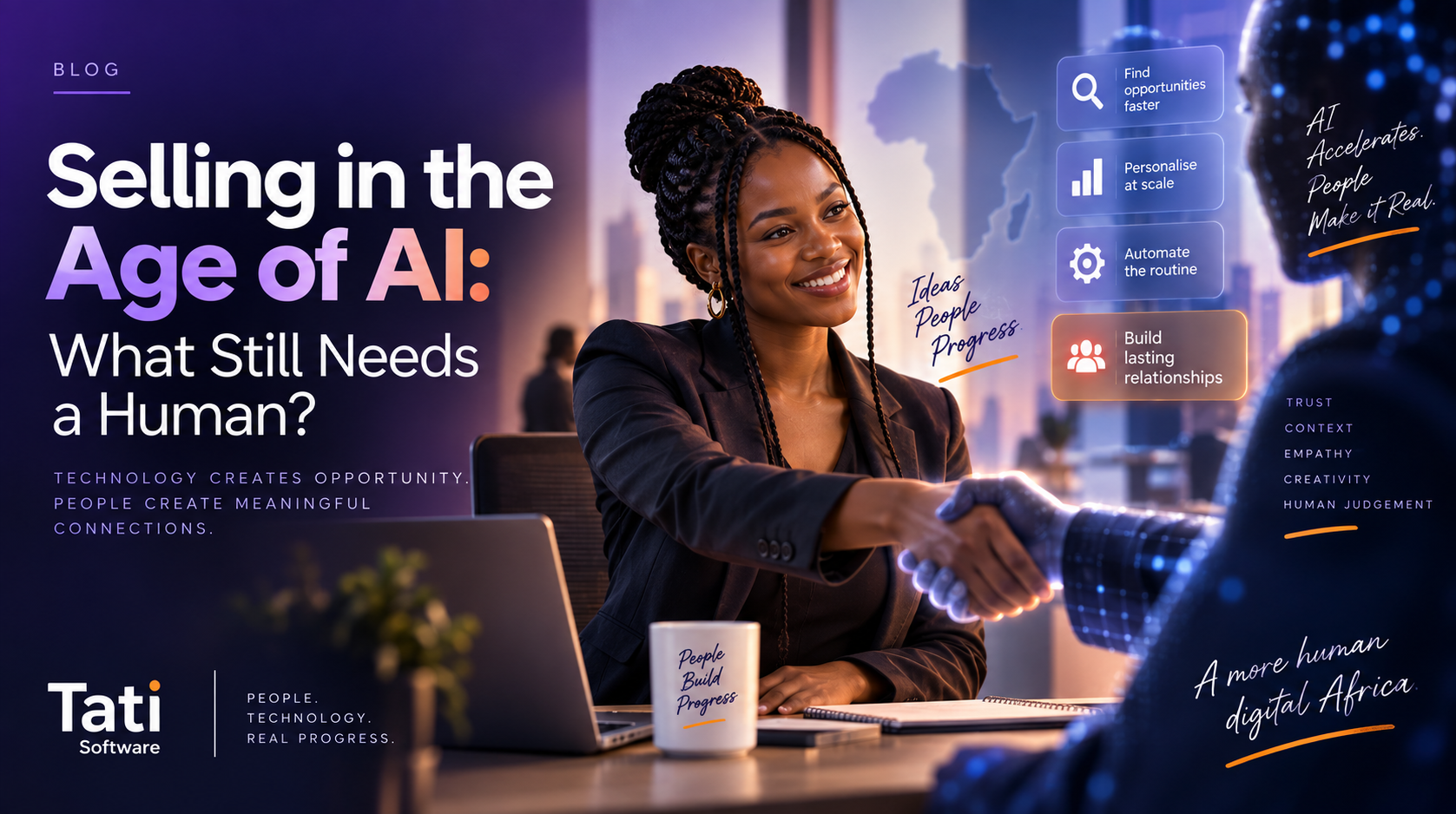
Selling in the Age of AI: What Still Needs a Human?
Artificial intelligence (AI) is rapidly changing how businesses attract customers, make sales and provide after-sales support. AI can research prospects, analyse buying behaviour, recommend products, prepare sales communication, answer routine questions and follow up with many customers at once. It gives businesses the ability to work faster, personalise customer experiences and make better use of their information.
However, AI adoption remains uneven across Africa. Many small and medium-sized businesses still view it as technology intended for large corporations. Some business owners associate AI only with tools such as ChatGPT, while employees may fear that using AI will eventually lead to job losses.
The real challenge is not a lack of intelligence or innovation. It is a gap in exposure, digital skills, infrastructure and practical understanding. Many businesses do not yet recognise how AI can solve ordinary operational problems.
For example, a warehouse could use AI to predict stock requirements, while a mining company could use it to anticipate equipment maintenance. Retailers could analyse customer behaviour to recommend relevant products, and sales teams could automate prospect research, meeting preparation and follow-up communication.
This opportunity is particularly important in South African industries where operations are still managed through spreadsheets, emails, paper documents, telephone calls and WhatsApp messages.
Businesses do not necessarily need complex or expensive AI systems. They should begin by asking a practical question:
"Where are we losing time, money, customers or information?"
Once the problem is understood, an appropriate technological solution can be identified.
Chinese Businesses, Temu Display What AI-Powered Selling Can Look Like
Temu offers a familiar example of how Chinese companies use technology to improve sales and service in South Africa.
Temu entered the South African market in January 2024 and quickly became a recognisable online shopping platform. Its success is supported by competitive pricing, convenient mobile shopping and the intelligent use of customer data.
When customers search for products, view items or place something in their baskets, the platform learns from their behaviour. It uses that information to recommend similar products, present personalised promotions and remind customers about incomplete purchases.
Technology supports almost the entire customer journey, from discovering products and completing purchases to tracking deliveries and managing return or refund requests. Temu demonstrates how data, automation and personalisation can help a company enter a new market and grow quickly.
AI Creates Speed, but Humans Build Trust
Despite these advances, selling remains a deeply human activity. AI can identify a potential need, but it cannot always understand the full context behind it.
AI might indicate that a company needs an inventory-management system. A salesperson must still discover why stock is being lost, how the problem affects the business, who manages the process and whether employees are prepared to adopt a new system.
This is especially important in business-to-business sales. Companies investing in custom software or changing an important operational system need more than product information. They need confidence that the service provider understands their organisation, can deliver what was promised and will remain available when difficulties arise.
A customer may say they are still considering a proposal, but the real concern may be budget, internal approval, fear of change or a previous negative experience. AI can process the customer's words, but an experienced salesperson can recognise hesitation, ask sensitive questions, negotiate and adjust the conversation.
AI can begin and support a conversation. Humans build the trust that moves it forward.
The Human Role Is Essential After the Sale
The strength of a customer relationship is often tested after payment has been made.
AI can provide order updates, onboarding instructions, renewal reminders and answers to frequently asked questions. It can also identify patterns in complaints and alert the business when a customer may be unhappy.
However, a customer experiencing a serious problem does not always want another automated response. A delayed delivery may have caused a financial loss, while a software failure may have interrupted an important operation. These situations require empathy, judgement, accountability and clear communication.
AI should therefore handle routine and predictable enquiries so that employees have more time to resolve complex problems. It should help businesses remember customer commitments and identify dissatisfaction early—not remove people from the relationship.
The future of after-sales service is not AI versus people. It is AI providing speed and consistency while people provide care and responsibility.
Africa Can Combine AI With Its Human Strength
Africa does not need to copy every solution used in China. Technology must be adapted to local realities such as affordability, connectivity, languages, skills and customer behaviour.
Retailers could use AI to predict demand while still assisting customers through WhatsApp and telephone calls. Logistics and waste-management companies could automate driver schedules, route information, document collection and invoicing, while managers handle safety decisions and exceptional circumstances. Software companies could use AI for prospect research and proposal preparation, while sales teams lead discovery meetings and build client relationships.
Salespeople should view AI as a tool rather than a competitor. It can help them research prospects, prioritise leads, prepare for meetings, draft communication, summarise notes and identify patterns in customer objections. Nevertheless, people must verify its information, protect confidential data and decide whether its recommendations are appropriate.
African business already has a strong relationship-driven culture built on trust, personal introductions and long-term connections. AI should support these strengths, not remove them.
The future of selling will be human-led and AI-supported. Technology will take over repetitive tasks, but people will remain responsible for trust, context, empathy, creativity and accountability.
The businesses that succeed will understand what AI does well—and recognise when a customer still needs a human.