From Proof of Concept to Production: Making AI Actually Work
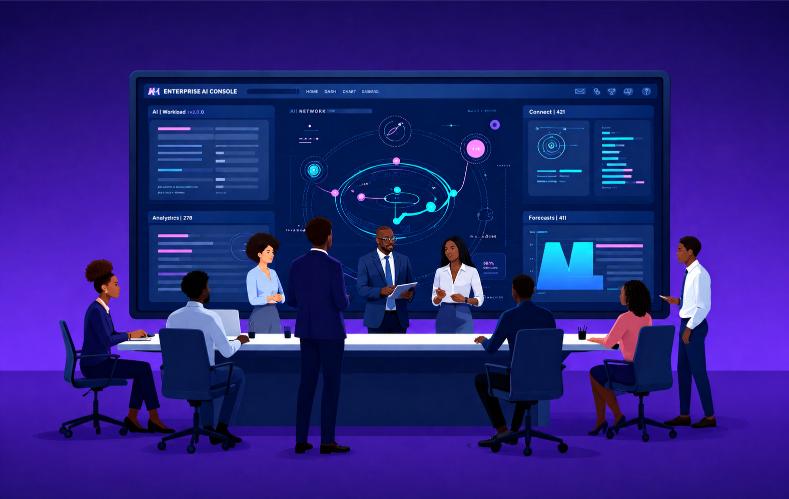
Artificial intelligence has become one of the most talked-about business tools of our time. In boardrooms, team meetings, strategy sessions, product discussions, and even casual business conversations, AI keeps coming up. Almost every company has either tested it, discussed it, watched a demo, or wondered how it could fit into their operations.
And honestly, it is not difficult to understand why.
Some of the demos are impressive. A model summarizes a long document in seconds. A chatbot responds to customer questions in a smooth, natural way. An AI assistant drafts content, organizes information, pulls insights from data, or automates a task that used to take someone hours to complete manually.
In that early proof-of-concept stage, everything can feel exciting. It feels like the business has discovered a new level of efficiency. It feels like a breakthrough is just around the corner. It feels like the team is standing right at the edge of something transformational.
But this is also the point where many AI projects quietly begin to lose momentum.
Because getting AI to work in a controlled demo is one thing. Getting it to work inside a real business, with real people, real customers, imperfect data, changing priorities, operational pressure, and all the moving parts of daily work, is something very different.
That is the real gap between proof of concept and production.
A proof of concept shows that an idea has potential. Production proves that the idea can create value consistently.
And that gap is where the real work begins.
What a Proof of Concept Really Is
A proof of concept is a small, focused test. It is designed to answer one simple question: can this idea work?
That is what it is.
What it does is help a business explore whether AI is worth pursuing for a specific use case. Maybe the team wants to see if AI can summarize reports, respond to customer queries, classify support tickets, extract information from documents, assist with internal workflows, or help employees find information faster.
At this stage, the goal is not perfection. The goal is possibility.
A proof of concept gives the team a safe space to test an idea before committing too much time, money, or operational energy. It helps reduce uncertainty. It allows decision-makers to see what is possible. It gives teams a chance to learn quickly, ask better questions, and understand whether the concept deserves more serious investment.
That is useful. In many cases, it is necessary.
But it is important to be honest about what a proof of concept does not prove.
It does not prove that the system is ready for everyday business use. It does not prove that the output will remain reliable when the inputs become messy. It does not prove that employees will adopt it. It does not prove that customers will trust it. And it does not prove that the business is ready to depend on it.
A proof of concept is a starting point, not the finish line.
It is the business saying, “This looks promising.”
Production is the business saying, “This is now reliable enough to support the way we work.”
What Production Actually Means
Production is the stage where AI stops being an experiment and starts becoming part of the business.
That is what it is.
What it does is place AI inside real workflows, where it has to deliver practical, repeatable, and accountable results. It is no longer sitting on the side as an interesting test. It is now expected to support real people doing real work.
This is where the standard changes.
In a proof of concept, it may be enough for the AI to be clever. In production, clever is not enough. The system has to be useful. It has to be stable. It has to be trusted. It has to fit into the business without creating more confusion than value.
This is where many organizations realize that the hardest part of AI is not getting a result. The hardest part is making that result dependable.
In a proof of concept, the environment is usually clean. The inputs are selected carefully. The scope is narrow. The users are often people who already understand the project and know how to work around the system’s weaknesses.
Production does not give you that comfort.
Production brings real users. It brings unclear instructions, incomplete information, inconsistent data, edge cases, integration issues, security concerns, accountability questions, and the very human expectation that a business tool should simply work.
That is why production is such an important milestone. It is the point where AI has to stop being impressive in theory and start being useful in practice.
Why So Many AI Pilots Stall
This is the part of the AI conversation that does not always get enough attention.
Many AI projects do not fail because the technology is useless. They fail because the business mistakes an interesting prototype for an operational solution.
A team runs a pilot. The results look good. Stakeholders get excited. There is talk of rollout, transformation, automation, scale, and competitive advantage. Everyone can see the potential.
Then the project gets closer to real use, and the cracks begin to show.
The data feeding the system is incomplete. Different departments follow different processes. The AI performs well in some cases but poorly in others. Employees are not sure when to trust it. Customers ask questions the system was never prepared to handle. No one is fully sure who owns the system after launch. And because success was never clearly defined, the project starts to feel vague.
That is usually where adoption slows down.
Not because the idea was bad. Not because AI had no value. But because the structure around the idea was not strong enough.
This is a lesson many businesses learn the hard way: AI does not become valuable simply because it can generate an answer. It becomes valuable when the business can rely on that answer in a real operating environment.
That is a much higher standard.
And it is the standard that separates experiments from business capability.
The Real-World Shift: From Clean Tests to Messy Operations
The moment AI enters day-to-day operations, everything changes.
In theory, an AI solution may look polished. In practice, it has to survive the normal complexity of business life.
It has to work with data that is not always clean. It has to handle requests that are not always phrased perfectly. It has to fit into workflows that may have been designed long before AI was ever part of the conversation. It has to support employees with different levels of technical confidence, different work habits, and different expectations.
And on top of all of that, it has to make sense for the business.
That is why organizations need to move beyond asking, “Can AI do this?”
That is only the first question.
The better question is, “Can AI do this reliably enough to matter?”
Can it produce consistent output? Can it handle exceptions? Can it work within existing systems? Can the business monitor what it is doing? Can teams step in when something goes wrong? Can leaders measure whether it is actually improving anything?
Those are production questions.
And they matter far more than the excitement of the first demo.
A demo shows what is possible under the right conditions. Production shows whether the solution can keep delivering when conditions are no longer perfect.
The Biggest Misconception: Treating AI Like a Feature Instead of a System
One of the biggest reasons businesses struggle to move AI into production is that they treat it like a standalone feature.
They assume the model is the product.
It is not.
The model is only one part of the solution. The real solution includes everything around it: the data, the workflow, the controls, the review process, the user experience, the monitoring, the ownership, and the business rules that guide how the AI should behave.
This is something many teams discover too late.
A strong prompt is not enough. A good model is not enough. Even a successful pilot is not enough.
For AI to work in production, it has to be supported like any other serious business capability. It needs structure. It needs governance. It needs clear responsibilities. It needs ongoing attention. It needs people who understand not only what the technology can do, but how it should fit into the way the business actually operates.
In other words, AI needs to be treated less like magic and more like infrastructure.
That may sound less exciting than the typical AI headlines, but it is far more useful.
Because businesses do not grow through impressive demos alone. They grow through systems that help people work better, make better decisions, serve customers more consistently, and reduce unnecessary friction.
That is where AI becomes meaningful
What Makes AI Actually Work
This is where the conversation becomes more practical.
If a business wants AI to move from experimentation to execution, it has to focus on the fundamentals. Not the hype. Not the buzzwords. Not the pressure to “use AI” simply because everyone else is talking about it.
The first fundamental is clarity.
AI works best when it is tied to a specific business problem. Not a vague ambition to be innovative, but a real problem with a real cost. That problem might be slow response times, repetitive administrative work, inconsistent document handling, delayed decision-making, poor lead follow-up, scattered company knowledge, or manual processes that keep pulling skilled people away from higher-value work.
When the problem is clear, the use case becomes clearer. And when the use case is clear, it becomes much easier to design the solution properly, guide the AI properly, and measure whether it is actually working.
The second fundamental is workflow fit.
AI should make work easier, not more complicated. If it sits outside the normal flow of work, adoption becomes difficult. If employees need too many extra steps to use it, they will avoid it. If the output creates more correction work than it saves, trust will disappear very quickly.
The best AI systems are often not the loudest or flashiest ones. They are the ones that fit naturally into the work people are already doing. They remove friction. They reduce repetition. They help teams move faster without forcing them to completely rethink their day.
The third fundamental is human oversight.
In a business setting, especially where quality, compliance, customer relationships, financial decisions, or reputation are involved, AI should not operate in a vacuum. It should support human decision-making, not replace responsibility.
That does not mean AI is weak. It means the business is being practical.
Human oversight creates confidence. It gives teams a safety net. It makes it easier to improve the system over time because people can see where the AI performs well, where it struggles, and where the workflow itself may need to change.
The fourth fundamental is measurement.
A surprising number of AI initiatives go live without a clear definition of success. People talk about efficiency, innovation, automation, and productivity, but they do not always define what improvement should actually look like.
Does success mean faster turnaround time? Better lead qualification? More consistent customer support? Fewer repetitive tasks? Lower operating costs? Better document accuracy? Stronger response quality? Less time spent searching for internal information?
If those answers are not clear, then the AI may look impressive while delivering very little measurable business value.
The fifth fundamental is iteration.
Production AI is not something a business launches once and then forgets about. It needs tuning. It needs observation. It needs feedback. It needs correction. As people start using it in real workflows, new issues will appear. New opportunities will appear too.
That is normal.
The businesses that make AI work are usually not the ones chasing the biggest claims. They are the ones willing to improve the system steadily, based on real usage, real feedback, and real outcomes.
That is the practical work. And in many ways, it is the work that matters most.
Trust Is the Real Milestone
Many AI projects are judged too early.
A pilot works, and people assume the difficult part is over. In reality, the difficult part has only just begun.
Because once the system enters everyday use, the question becomes less about capability and more about trust.
Will people use it consistently? Will they believe the output? Will they know when to rely on it and when to review it more carefully? Will managers feel confident putting it into team workflows? Will leaders feel confident enough to keep investing in it?
Trust is what separates an interesting AI tool from a useful one.
And trust is not built through hype. It is built through consistency, clarity, accountability, and experience.
People trust systems that help them do their jobs better. They trust systems that reduce confusion instead of adding to it. They trust systems that fit into the business instead of disrupting it for the sake of novelty.
That is why production matters so much.
It is where trust is either built or lost.
A business can have the most impressive AI demo in the room, but if people do not trust the system in real work, adoption will always be limited. On the other hand, even a simple AI use case can become incredibly valuable if it is dependable, well-designed, and properly embedded into the way the team operates.
From Experimentation to Real Business Value
AI absolutely has the potential to change how businesses operate. It can reduce friction, speed up work, improve decision-making, support better customer experiences, and unlock efficiencies that were previously difficult to achieve.
But none of that happens simply because a proof of concept looked good in a meeting.
It happens when a business does the harder work of turning a promising idea into something dependable.
A proof of concept may prove possibility. Production proves readiness.
A prototype may generate excitement. Production generates confidence.
And in the end, making AI actually work is not about whether the technology sounds impressive. It is about whether it can deliver value in the real world, where systems are imperfect, people are busy, teams are stretched, and results have to stand up to daily use.
That is the journey from proof of concept to production.
It is the journey from excitement to execution.
And it is where AI stops being a promising experiment and starts becoming a serious business asset.
Shared via Skhokho