

Why Empathy Is a Technical Skill — and Why We Need It More Than Ever
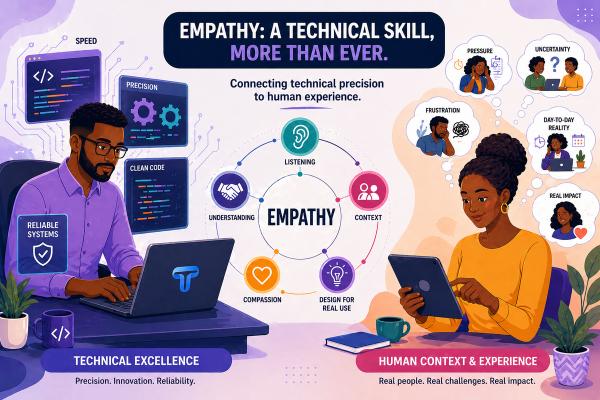
In technical environments, excellence is often defined by speed, precision, and innovation. Teams are expected to build reliable systems, solve complex problems, and continuously improve how work gets done. In fast-moving environments such as Tati Software, this momentum is essential to staying competitive and responsive in a rapidly evolving technological landscape.
However, while systems evolve quickly, people do not always adapt at the same pace. People do not engage with technology purely through logic or efficiency. They engage with it through context, experience, and the realities of their day-to-day work. They bring pressure, uncertainty, and varying levels of understanding into every interaction.
This creates a gap between how systems are designed and how they are experienced in practice. What appears intuitive from a technical perspective can feel unclear or overwhelming in real-world use. This gap is often where operational challenges begin, and where empathy becomes essential.
A system can be technically correct and still create frustration
From an HR and Quality perspective, the relationship between people, processes, and technology becomes especially clear. Systems are not only evaluated based on functionality, but also on how they are experienced by the people using them. A system can be technically correct and still create frustration, just as a process can meet every compliance requirement and still feel difficult to follow.
These outcomes are often the result of misalignment. There is a difference between what was intended during design and what is experienced in practice. That difference can create confusion, inefficiency, and friction, even when everything appears to be working as expected.
Understanding this misalignment requires more than technical analysis. It requires empathy.
The human context behind every system
It is easy to think of systems as structured and predictable, but they exist within human environments that are far more dynamic. Behind every system interaction is a person trying to complete their work, often under pressure and within constraints that are not always visible. Behind every error is someone who feels blocked or uncertain. Behind every process is someone trying to interpret instructions and meet expectations.
When this human context is overlooked, systems may function correctly in theory but create challenges in practice. Processes may be efficient but still difficult to navigate, and communication may be structured yet still lack clarity.
Empathy ensures that technical decisions remain connected to the people they impact.
Empathy in everyday interactions
In many cases, meaningful improvement does not come from large-scale system changes, but from smaller, more intentional actions. Taking the time to listen carefully before responding, asking questions to better understand context, and recognising when someone may be struggling can significantly change outcomes.
These actions reduce misunderstandings, improve communication, and strengthen collaboration. Over time, they contribute to more effective systems and stronger teams.
Empathy, in this sense, is practical. It shapes how people interact, communicate, and solve problems daily.
Rethinking empathy as a technical capability
Empathy is often described as a soft skill, but this does not fully reflect its role in technical environments. It requires attention, discipline, and intention. It involves listening, observing patterns, and questioning assumptions that may otherwise go unchallenged.
In many ways, empathy reflects the same mindset used in technical problem-solving. It requires curiosity, analysis, and a willingness to understand underlying causes rather than surface-level issues.
Seen in this way, empathy is not separate from technical skill. It strengthens it by adding context and depth to decision-making.
Designing for real-world use
A common challenge in technical environments is designing systems based on ideal conditions rather than real-world behaviour. It is often assumed that users will follow instructions carefully, apply processes consistently, and operate with full context.
In reality, people are managing multiple priorities, working under pressure, and often navigating unfamiliar systems. When systems are designed without considering these realities, friction becomes inevitable.
Empathy helps shift the focus from how systems should work to how they are actually experienced. It allows teams to design solutions that are not only functional but usable and effective in practice.
Quality, collaboration, and the role of empathy
From a quality perspective, it is important to expand how success is defined. Quality is often measured through compliance and technical correctness, but this is only part of the picture. True quality considers whether systems work effectively in practice and whether people can use them with confidence.
Empathy also plays a critical role within teams. Technical work is inherently collaborative, involving individuals with different roles, perspectives, and pressures. Without empathy, these differences can create friction. With empathy, they create alignment.
Teams that understand one another’s context communicate more effectively, raise concerns earlier, and collaborate more productively. This leads to better outcomes and more resilient systems.
Why empathy matters more than ever
As technology continues to evolve, the pace of change is increasing. AI, automation, and digital transformation are reshaping how work is done and how organisations operate. In this environment, there is constant pressure to move faster and deliver more.
Empathy ensures that progress remains meaningful. It helps organisations consider how systems are experienced and ensures that innovation does not come at the expense of usability or clarity.
It balances efficiency with experience, ensuring that systems support the people who rely on them.
Final thought
Empathy should not be treated as something separate from technical work or added at the end of a process. It needs to be present throughout the lifecycle of design, development, and implementation.
It ensures that systems are not only functional but effective in real-world use. It connects technical excellence to human experience.
Because ultimately, the value of any system lies not only in what it does, but in how well it supports the people who rely on it.