
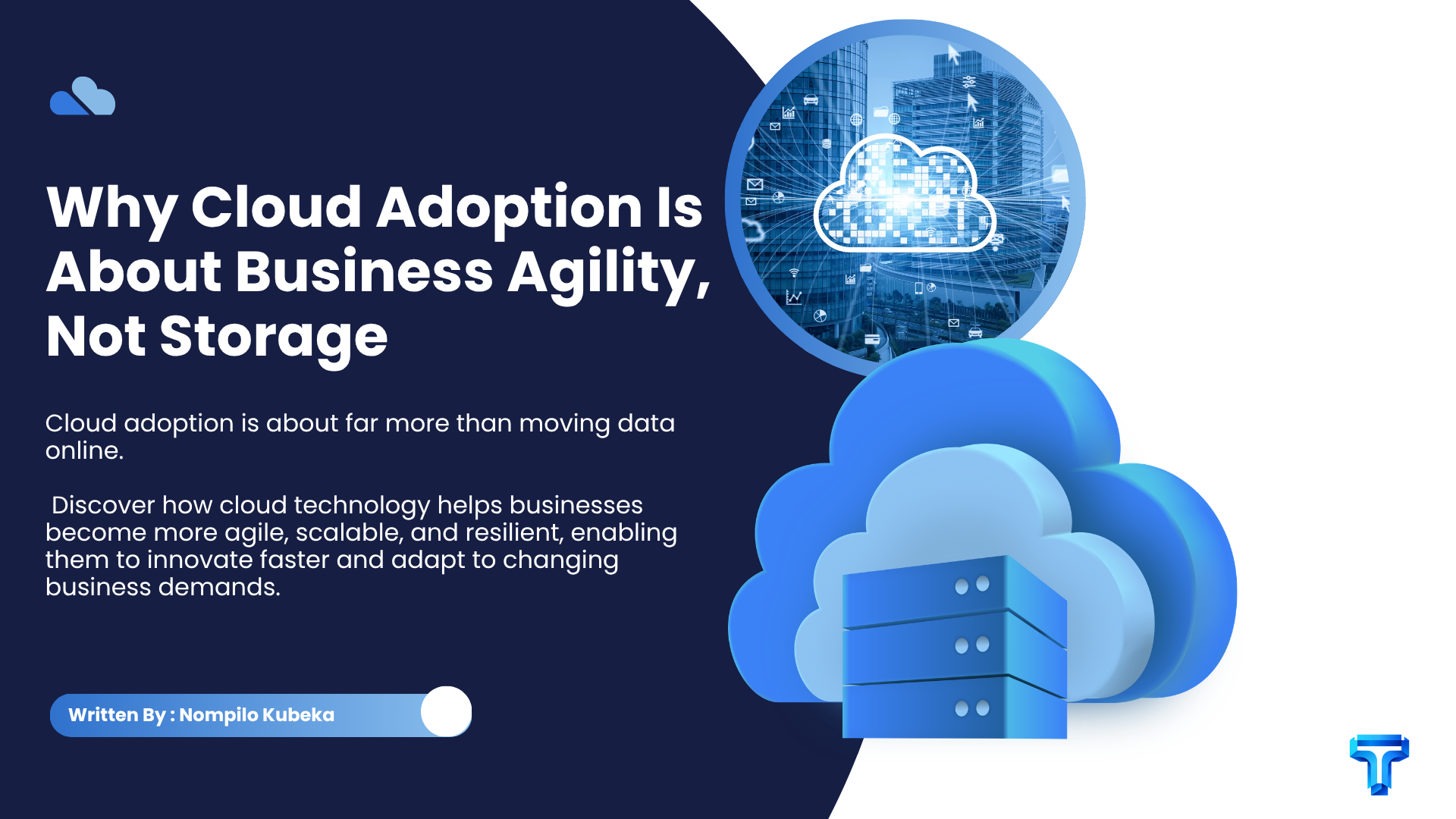
Why Cloud Adoption Is About Business Agility, Not Storage
Why Cloud Adoption Is About Business Agility, Not Storage
Looking Beyond the Cloud
For many years, cloud computing has been associated with one primary function: storage. Ask someone what the cloud is, and there is a good chance they will describe it as a place to store files instead of keeping them on a physical server or hard drive. While this understanding is not incorrect, it only scratches the surface of what cloud technology has evolved to become.
Today, cloud computing is far more than an alternative to traditional storage. It has become the foundation upon which modern businesses build applications, analyse data, deploy artificial intelligence, automate business processes, strengthen cybersecurity, and deliver better customer experiences. Organisations across every industry are using cloud technologies to innovate faster, improve operational efficiency, and remain competitive in markets that continue to evolve at an unprecedented pace.
The conversation has shifted from "Where should we store our data?" to "How can technology help our business adapt, grow, and innovate?"
That shift is significant because it changes how organisations think about cloud adoption. Rather than viewing it as an IT upgrade, businesses are increasingly recognising cloud computing as a strategic investment that supports long-term growth and enables them to respond more effectively to change.
For many organisations, the cloud represents a fundamental shift in how technology supports business strategy. It changes the conversation from maintaining infrastructure to enabling innovation, from reacting to business demands to anticipating them, and from managing limitations to creating new opportunities. Rather than viewing the cloud as another IT upgrade, forward-thinking organisations are recognising it as a platform for transformation that allows them to operate more efficiently, respond more quickly, and compete more effectively in an increasingly digital economy.
This shift is particularly important as businesses navigate rapid technological change. Customer expectations are evolving faster than ever before, competition is increasing across every industry, and organisations are under constant pressure to deliver better products and services while remaining cost-effective. Cloud computing provides the flexibility needed to meet these expectations without requiring businesses to continually rebuild their technology foundations.
In an increasingly competitive marketplace, agility has become one of the most valuable business capabilities an organisation can possess. Cloud technology enables that agility by giving businesses the flexibility to evolve without being constrained by traditional infrastructure.
Business Agility Is the Real Competitive Advantage
Business agility refers to an organisation's ability to respond quickly to changing market conditions, customer needs, and emerging opportunities without unnecessary delays or operational disruption.
Every business experiences change. Customer expectations evolve, industries become more competitive, economic conditions fluctuate, and new technologies reshape the way organisations operate. Businesses that can adapt quickly often gain a significant competitive advantage over those that struggle to respond.
Historically, adapting to change frequently meant investing in additional infrastructure. Expanding operations often required purchasing new servers, installing hardware, increasing data centre capacity, and waiting weeks—or even months—for technology to support new business initiatives. These delays often slowed innovation and made responding to new opportunities both expensive and time-consuming.
Cloud computing has fundamentally changed this approach.
Today, organisations can provision infrastructure within minutes instead of weeks. Computing resources can automatically scale to match demand, allowing businesses to introduce new products, launch digital services, or support increased customer activity without rebuilding their entire technology environment.
This flexibility enables organisations to focus less on managing infrastructure and more on delivering value to customers.
Business agility also enables organisations to respond confidently to uncertainty. Whether entering a new market, supporting seasonal demand, adapting to regulatory changes, or responding to unexpected disruptions, businesses need technology that can evolve as quickly as their environment does. Traditional infrastructure often struggles to provide that flexibility, whereas cloud platforms are designed to adapt dynamically to changing business requirements.
Organisations that embrace agility are often able to make decisions faster because they spend less time managing technology and more time focusing on strategy, innovation, and customer outcomes. In today's business environment, speed has become a competitive advantage, and cloud computing provides the technological foundation that makes that speed possible.
Cloud Enables Innovation
Innovation rarely happens by accident.
It is the result of continuous experimentation, learning, and improvement. Businesses need the freedom to test ideas, build prototypes, gather feedback, and refine solutions without making large financial commitments before they understand whether those ideas will succeed.
Traditional infrastructure often created significant barriers to innovation. Purchasing hardware, configuring environments, and investing in technology before validating an idea increased both cost and risk.
Cloud computing removes many of these obstacles.
Development teams can quickly create testing environments, experiment with new technologies, and deploy proof-of-concept solutions within hours rather than weeks. If an idea proves successful, resources can be expanded almost immediately. If it does not, those environments can simply be decommissioned, ensuring organisations only pay for what they use.
Innovation is rarely a single breakthrough. More often, it is the result of continuous experimentation, learning, and improvement. Businesses that can rapidly test ideas are better positioned to discover new opportunities, improve customer experiences, and remain competitive.
Cloud computing encourages this culture of experimentation by lowering the barriers to innovation. Instead of committing significant resources before understanding whether an idea will succeed, organisations can build, test, measure, and refine solutions quickly. This allows innovation to become part of everyday business operations rather than an occasional initiative driven by budget constraints.
Innovation is no longer reserved for organisations with large technology budgets. Cloud computing has made it possible for businesses of every size to explore new opportunities and compete in ways that were previously out of reach.
Building for Growth Instead of Catching Up
One of the greatest challenges facing growing businesses is ensuring that technology keeps pace with expansion.
A system that works perfectly for a small team may struggle as customer numbers increase, additional employees join the organisation, or new products and services are introduced. Performance begins to decline, processes become more complex, and operational inefficiencies start affecting customer experience.
Cloud computing addresses this challenge through scalability.
Instead of investing in infrastructure based solely on future predictions, organisations can increase computing power, storage capacity, databases, and networking resources whenever demand requires it.
Scalability is particularly important for organisations experiencing rapid growth. A business may begin with a handful of employees and customers, but as demand increases, technology must continue supporting that growth without compromising performance or customer experience.
Cloud platforms provide organisations with the confidence that their infrastructure can evolve alongside their ambitions. Instead of planning for today's workload alone, businesses can prepare for tomorrow's opportunities, knowing that additional resources can be provisioned when they are needed rather than months in advance.
Growth should be exciting—not something technology struggles to support.
Enabling the Modern Workplace
The way people work has changed dramatically over the past decade.
Hybrid work, remote collaboration, distributed teams, and international partnerships have become increasingly common across organisations of every size. Employees expect to access business systems securely from multiple locations while collaborating seamlessly with colleagues regardless of where they are based.
Cloud technology has become one of the key enablers of this new way of working.
Applications, documents, and business systems can be accessed securely through the internet, allowing employees to remain productive whether they are working from an office, from home, or while travelling.
Beyond flexibility, cloud platforms also improve collaboration. Teams can work on shared documents in real time, access centralised information, and communicate more effectively without relying on outdated methods of transferring files or maintaining multiple versions of the same document.
The cloud has also changed how organisations think about collaboration. Teams are no longer restricted by geography or physical office spaces. Employees can contribute from different cities, countries, or time zones while accessing the same systems, documents, and applications securely.
This level of accessibility enables businesses to build more flexible, inclusive, and productive workplaces. It also supports business continuity by ensuring that work can continue even when employees cannot access a physical office, making organisations more resilient to unexpected disruptions.
Business Continuity and Resilience
Unexpected disruptions can occur at any time.
Power failures, hardware failures, cyber incidents, natural disasters, or unforeseen operational challenges all have the potential to interrupt business operations.
One of the greatest advantages of cloud computing is its ability to improve business resilience.
Leading cloud providers invest heavily in redundancy, disaster recovery, security, and global infrastructure designed to minimise downtime.
Instead of relying on a single physical location, businesses can distribute workloads across multiple regions and availability zones, helping ensure that critical systems remain available even when unexpected events occur.
Resilience has become increasingly important in an environment where unexpected events can significantly impact operations. Organisations are expected to continue serving customers regardless of disruptions, making business continuity a strategic priority rather than simply an operational concern.
Cloud technologies provide businesses with greater confidence by reducing dependence on a single location or piece of infrastructure. Combined with effective disaster recovery planning and sound operational practices, cloud adoption enables organisations to recover more quickly and minimise the impact of unforeseen events.
Security Is a Shared Responsibility
One of the most common misconceptions about cloud computing is that moving to the cloud automatically solves every security challenge.
While cloud providers invest billions in securing their infrastructure, businesses also play an important role in protecting their own applications, identities, configurations, and data.
Cloud security is built on a shared responsibility model.
The cloud provider secures the underlying infrastructure, while organisations remain responsible for securing how they use cloud services.
Understanding the shared responsibility model is essential because security is most effective when both the cloud provider and the customer fulfil their respective roles. Businesses must establish strong identity management, implement multi-factor authentication, monitor their environments, and educate employees on security best practices.
Technology alone cannot eliminate cyber risk. Building a strong security culture remains equally important, ensuring that people, processes, and technology work together to protect business information and maintain customer trust.
When implemented correctly, cloud environments often provide security capabilities that would be difficult and expensive for many organisations to achieve independently.
Cloud Is the Foundation for Emerging Technologies
Many of today's most transformative technologies are built on cloud platforms.
Artificial intelligence, machine learning, advanced analytics, Internet of Things (IoT), automation, serverless computing, and business intelligence all rely on scalable computing resources that cloud environments provide.
Rather than investing heavily in specialised infrastructure, organisations can access these capabilities on demand, making advanced technologies significantly more accessible than they once were.
The cloud has significantly lowered the barriers to adopting emerging technologies. Capabilities that were once available only to large enterprises with substantial IT budgets are now accessible to organisations of almost any size.
This democratisation of technology allows smaller businesses to compete more effectively, innovate more rapidly, and leverage tools that were previously beyond their reach. As a result, cloud computing continues to drive innovation across industries, creating opportunities for organisations to differentiate themselves in increasingly competitive markets.
Cloud Adoption Is a Business Strategy
One of the biggest misconceptions surrounding cloud adoption is that it is purely an IT initiative.
In reality, cloud adoption is a business decision.
Every technology investment influences how efficiently employees work, how effectively organisations serve customers, how quickly new products reach the market, and how confidently businesses respond to future opportunities.
Successful cloud adoption therefore requires collaboration across the organisation. Business leaders, technology teams, operational managers, and decision-makers must work together to ensure technology investments align with broader business objectives.
This is why cloud initiatives should involve more than technical teams. Business leaders, operational managers, finance departments, and technology professionals all have a role to play in ensuring that cloud investments support broader organisational objectives. When technology decisions are aligned with business priorities, organisations are better positioned to maximise the value of their investments.
Cloud adoption should therefore be viewed as part of an organisation's long-term growth strategy. It is not simply about modernising infrastructure but about creating an environment where innovation, collaboration, efficiency, and continuous improvement become part of everyday business operations.
The most successful organisations do not adopt cloud technologies simply because they are modern.
They adopt them because they enable measurable business outcomes.
Final Thoughts
Cloud computing has evolved far beyond online storage.
Today, it provides the foundation for innovation, collaboration, resilience, automation, artificial intelligence, and sustainable business growth.
Organisations that embrace cloud technology are not simply changing where they store information. They are creating businesses that are more agile, scalable, and prepared for the challenges and opportunities of tomorrow.
As businesses continue navigating an increasingly digital world, the ability to respond quickly will become even more important. Organisations that invest in scalable, resilient, and flexible technology foundations will be better equipped to embrace future innovations, respond to changing customer expectations, and remain competitive in rapidly evolving markets.
Cloud computing is no longer just another technology trend—it has become an essential enabler of business transformation. Organisations that understand its strategic value are not simply preparing for the next technology upgrade; they are building the capability to adapt, innovate, and grow for years to come.
Cloud adoption is not about moving data.
It is about building a business that can respond, adapt, innovate, and grow with confidence in an increasingly digital world.