
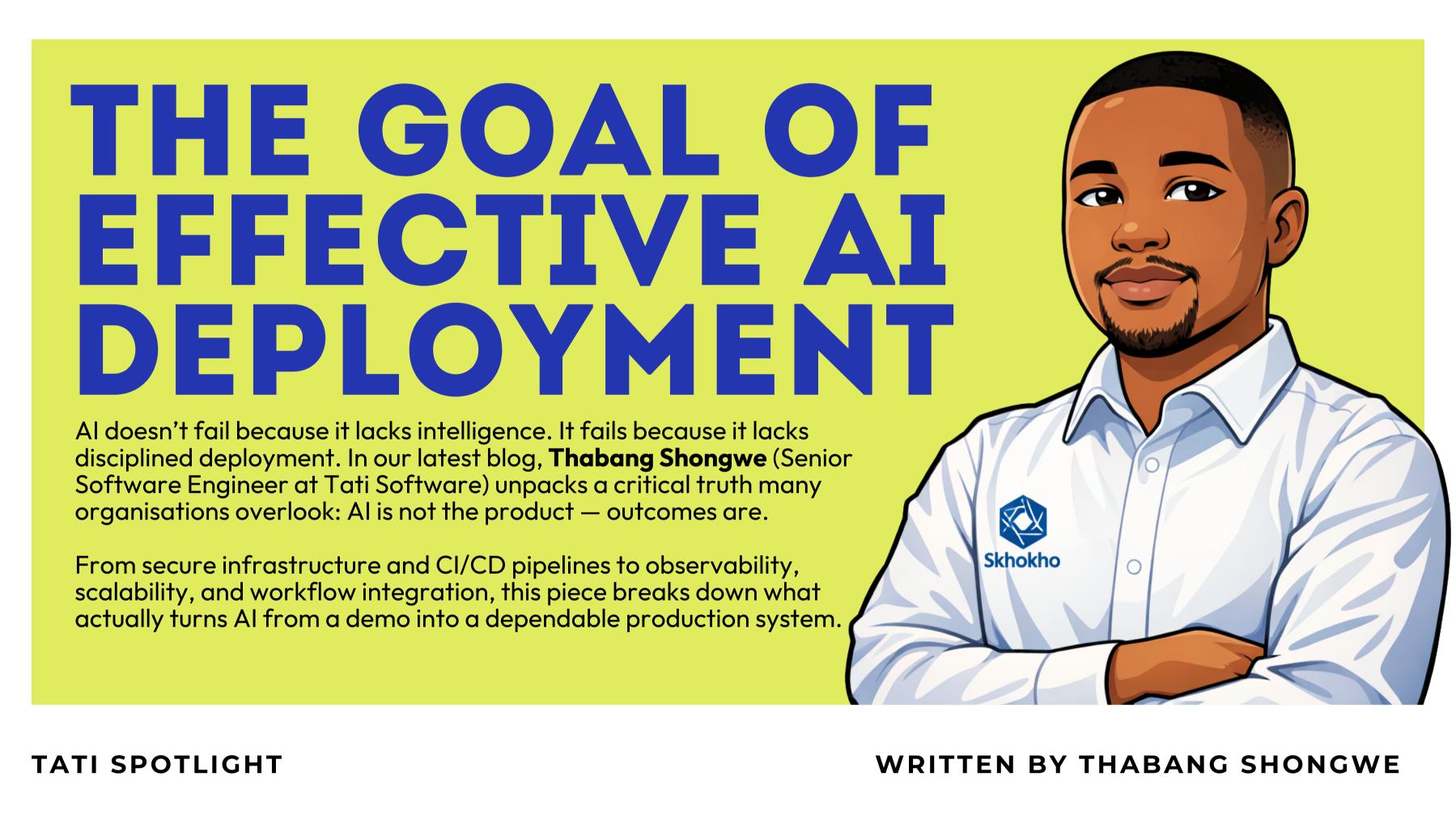
Lessons from Building Skhokho AI
Artificial Intelligence is everywhere. From recommendation engines to chatbots to predictive analytics, AI has moved from novelty to necessity.
But despite the hype, many AI initiatives quietly fail — not because the models are bad, but because the deployment is ineffective.
The real goal of AI deployment isn’t just to build something intelligent. It’s to deliver reliable, scalable, secure, and business-aligned intelligence that actually gets used.
This is a lesson we’ve learned firsthand while building Skhokho AI.
AI Is Not the Product — Outcomes Are
A common mistake organizations make is treating AI as the end goal:
“We need to use AI because everyone else is.”
But users don’t care about models. They care about outcomes.
Effective AI deployment starts with a simple question:
What decision, action, or experience is this AI-driven application supposed to improve?
Skhokho AI was designed with this mindset from day one. Instead of leading with algorithms, we focused on practical outcomes — insights that help teams move faster, automate intelligently, and understand their data without friction.
AI is not the product.
The outcome is.
Deployment Is Where Most AI Projects Break
Training a model is often the easiest part. The hard part is everything that comes after:
- Secure infrastructure
- Scalable environments
- Secrets and configuration management
- Monitoring and observability
- CI/CD pipelines
- Reliability under real-world traffic
This is where DevOps becomes essential.
Many AI systems never make it past experimentation because deployment is treated as an afterthought. A notebook demo is mistaken for a production system.
At Skhokho AI, deployment is treated as a first-class concern:
- Containerized services for consistency across environments
- Infrastructure as Code for reproducible environments
- Automated CI/CD pipelines for safe, repeatable releases
- Managed secrets and configuration to prevent drift
- Cloud-native orchestration for resilience
AI without DevOps is fragile. AI with DevOps becomes dependable.
AI Must Be Trustworthy and Observable
If users don’t trust an AI system, they won’t use it.
Trust isn’t built through accuracy alone. It’s built through reliability and transparency.
Effective AI deployment means:
- Knowing when the system is healthy
- Detecting failures before users do
- Understanding performance and latency over time
- Monitoring model behavior in production
- Being able to trace and debug issues quickly
This is where observability becomes critical. Logging, metrics, distributed tracing, and alerting are not “nice to have” — they are foundational.
In Skhokho AI, intelligence without visibility is considered a liability.
Every production system must be observable, measurable, and diagnosable.
That’s DevOps thinking applied to AI.
Scalability Is a Requirement, Not a Nice-to-Have
AI systems that work for 10 users often collapse at 10,000.
Effective deployment means designing for growth from the beginning:
- Stateless services
- Horizontal scaling
- Load-balanced APIs
- Managed databases and caching
- Secure networking and isolated environments
DevOps disciplines like capacity planning, autoscaling policies, and infrastructure automation ensure the system scales predictably.
Skhokho AI leverages cloud-native patterns so that as usage grows, the system grows with it — without requiring manual firefighting.
Scaling should be engineered, not improvised.
Automation Is the Backbone of Reliability
One of the most overlooked aspects of AI deployment is automation.
Manual deployments introduce risk. Manual configuration introduces inconsistency. Manual scaling introduces outages.
DevOps principles demand:
- Automated testing before release
- Infrastructure defined as code
- Continuous integration
- Continuous delivery
- Environment parity across development, staging, and production
For Skhokho AI, automation reduces human error and increases confidence in every deployment.
When AI systems are automated end-to-end — from build to release to monitoring — they move from experimental to operational.
AI Should Fit Into Existing Workflows
The best AI application is the one users don’t have to think about.
If an AI system forces teams to radically change how they work, adoption suffers. DevOps teaches us to optimize systems around people, not force people to adapt to systems.
Effective Skhokho deployment means integrating AI into:
- Existing dashboards
- Existing workflows
- Existing tools and pipelines
Skhokho AI focuses on being an enabler, not a disruption — enhancing workflows rather than replacing them.
Great AI is invisible in the right ways.
The Real Goal of AI Deployment
At its core, effective AI deployment is about alignment:
- Alignment with business goals
- Alignment with user needs
- Alignment with operational realities
- Alignment with engineering best practices
AI succeeds not when it’s impressive, but when it’s:
- Useful
- Reliable
- Scalable
- Secure
- Observable
- Continuously improving
That is DevOps applied to intelligence.
Skhokho AI exists to bridge the gap between powerful AI capabilities and real-world execution — turning intelligence into impact.
Final Thought
AI doesn’t fail because it’s too complex.It fails because it’s deployed without discipline.
The future belongs to teams who treat deployment as seriously as innovation — who understand that DevOps is not separate from AI, but foundational to it.
The goal of AI is not intelligence alone.
It is intelligence that works.