Responsible AI For SMEs
Responsible AI: Ethical Considerations for Small and Medium-Sized Enterprises (SMEs)
Artificial intelligence is rapidly changing how businesses operate. What was once considered advanced or inaccessible technology is now becoming part of everyday business operations for organisations of all sizes. Small and medium-sized enterprises (SMEs) are increasingly using AI to automate tasks, improve customer experiences, support decision-making, and increase efficiency.
For many SMEs, AI presents significant opportunities. It can help businesses save time, reduce operational costs, and remain competitive in fast-moving digital environments. However, as AI adoption grows, so does the responsibility to ensure that these technologies are used ethically and responsibly.
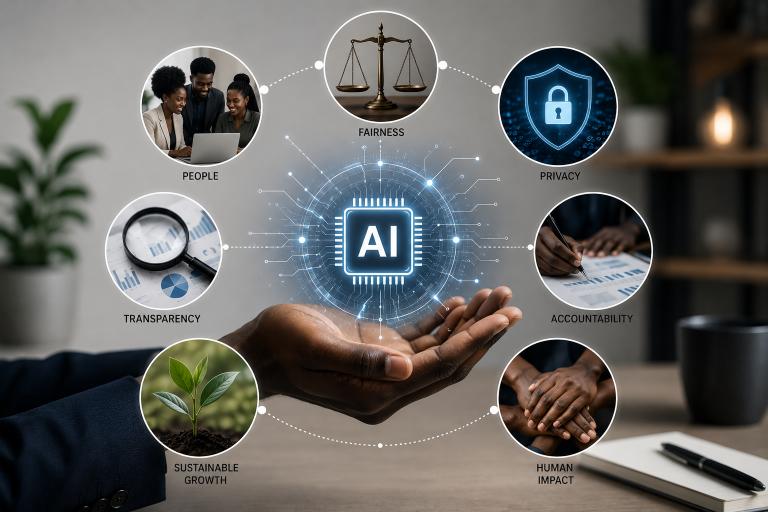
Responsible AI refers to the development and use of AI systems in ways that are fair, transparent, accountable, and aligned with human values. For SMEs, this is not simply a technical issue or a future concern. It is becoming an important part of building trust, protecting reputation, and ensuring sustainable business growth.
Why Responsible AI Matters for SMEs
There is often a misconception that ethical AI discussions only apply to large technology companies. In reality, SMEs are increasingly using AI-powered tools in recruitment, marketing, customer engagement, analytics, finance, and operations.
Even when businesses rely on third-party AI platforms rather than developing systems internally, they are still responsible for how these technologies affect people and processes.
AI-driven decisions can influence customer experiences, workplace processes, hiring outcomes, and access to opportunities. Because of this, SMEs cannot afford to treat AI as a “set-and-forget” solution. Responsible use requires oversight, awareness, and a clear understanding of how these systems impact both the business and the people connected to it.
Bias, Fairness, and Ethical Decision-Making
One of the most widely discussed concerns in AI is algorithmic bias.
AI systems rely heavily on data to learn patterns and make decisions. If the data used to train these systems reflects historical inequalities or existing biases, the outcomes produced by the AI may also be unfair or discriminatory.
For example, AI tools used in recruitment may unintentionally favour certain candidates if the training data lacks diversity. Similarly, AI systems used for recommendations, profiling, or financial assessments may reinforce patterns that disadvantage certain individuals or groups.
For SMEs, this is particularly important because many businesses adopt AI tools without fully understanding how the underlying systems operate. Responsible AI requires businesses to critically evaluate outputs rather than assuming automated decisions are always accurate or objective.
Using diverse datasets, conducting regular reviews, and maintaining human oversight can help reduce the risk of unfair outcomes.
Transparency, Privacy, and Trust
Transparency is another important aspect of responsible AI.
Many AI systems operate through complex processes that are difficult for users to fully understand. This lack of visibility can create confusion or distrust, particularly when AI is involved in customer interactions, pricing, recommendations, or decision-making processes.
Customers and employees increasingly want to understand when AI is being used and how it influences outcomes that affect them. Businesses should therefore aim to communicate openly about how AI supports their operations and decision-making processes.
Closely connected to transparency is the issue of data privacy.
AI systems often rely on large amounts of data, including personal or sensitive information. SMEs must ensure that data is collected responsibly, stored securely, and used in ways that comply with relevant regulations and ethical standards.
Responsible data practices include:
limiting unnecessary data collection
securing systems against breaches
maintaining transparency with users
ensuring responsible handling of sensitive information
Strong data governance is not only important for compliance, but also for maintaining customer t
Human Oversight and Accountability
Although AI systems can automate tasks and support decision-making, they do not eliminate human responsibility.
Businesses remain accountable for the outcomes produced by the technologies they implement. This is particularly important when AI influences decisions related to people, finances, or operations.
Responsible AI requires clear governance structures and ongoing human oversight. SMEs should establish who is responsible for monitoring AI systems, reviewing outputs, and responding to issues when they arise.
AI can improve efficiency and support better decision-making, but it should not completely replace human judgment. Maintaining this balance helps businesses reduce risk while ensuring accountability remains clear.
The Human Impact of AI
Beyond operational concerns, SMEs should also consider the broader human impact of AI adoption.
While AI can improve productivity and efficiency, it may also affect workplace dynamics, employee responsibilities, and required skill sets. Employees may feel uncertain about automation or concerned about how emerging technologies could influence their roles.
Responsible businesses recognise that successful AI adoption is not only about technology — it is also about people.
This means investing in employee training, supporting upskilling initiatives, and helping teams adapt to changing environments. Businesses that support their workforce through technological change are more likely to build resilient and adaptable organisations. AI should enhance human capability, not simply replace it.
Final Thought
AI presents significant opportunities for SMEs, but its adoption should be approached thoughtfully and responsibly.
Ethical considerations such as fairness, transparency, privacy, and accountability are no longer discussions reserved for large enterprises. They are becoming essential considerations for businesses of all sizes.
Responsible AI is not about slowing innovation. It is about ensuring that innovation remains trustworthy, sustainable, and aligned with human values.
As AI continues to shape the future of business, SMEs that adopt responsible AI practices will be better positioned to build trust, reduce risk, and create long-term value in an increasingly digital world.