

AI in Africa
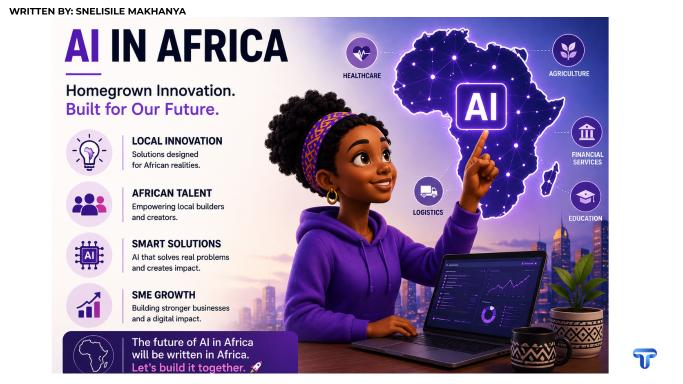
AI in Africa: Homegrown Innovation and Why Building Locally Matters
Africa’s AI Future Must Be Built in Africa
For years, Africa has often been positioned as a consumer of global technology, importing platforms, adapting foreign systems, and working around solutions that were never designed for its realities. But artificial intelligence is creating a rare opportunity for the continent to change that narrative entirely.
Across Africa, a new generation of entrepreneurs, engineers, and innovators is beginning to build technology rooted in local context rather than global assumptions. This shift matters because the challenges facing African businesses, healthcare systems, agricultural sectors, and public services cannot always be solved by importing models trained for entirely different economies, languages, infrastructures, and customer behaviours.
The future of AI in Africa will not be defined by how quickly the continent adopts foreign technology. It will be defined by how effectively Africans build systems for African realities.
That opportunity is enormous. According to McKinsey, AI could contribute as much as $1.5 trillion to Africa’s economy by 2030. But economic potential alone is not the real story. The deeper transformation lies in what locally built AI could unlock: smarter healthcare systems in underserved communities, more efficient agricultural supply chains, accessible financial services, multilingual digital experiences, and entirely new industries powered by African talent.
We are already seeing early signs of this transformation. Companies like Flutterwave, Andela, and other African technology pioneers have proven that local innovation can compete globally when given the right environment to grow. Their success is not accidental. It is the result of founders, developers, and operators who understand the nuances of African markets , the infrastructure limitations, the customer behaviour, the operational constraints, and the opportunities that outsiders often overlook.
At the same time, building AI solutions in Africa still comes with significant challenges. Limited access to funding, inconsistent infrastructure, talent shortages, fragmented digital ecosystems, and uneven regulatory environments continue to slow progress for many startups. Yet these constraints are also shaping a culture of resilience and creativity that is becoming one of Africa’s greatest competitive advantages.
This is where operational scalability becomes just as important as innovation itself. Many startups fail not because the idea lacks potential, but because execution becomes difficult as teams grow and projects become more complex. Platforms like Skhokho help bridge that gap by enabling startups and growing businesses to manage projects, workflows, collaboration, and operational processes more effectively. For fast-moving technology teams building AI-driven products, operational discipline can become a critical differentiator between experimentation and sustainable growth.
The conversation around AI in Africa is no longer only about possibility. The momentum already exists. The real question is whether Africa will build an ecosystem capable of turning local intelligence into globally competitive innovation.
Africa’s AI Landscape Is Growing Faster Than Most People Realize
Artificial intelligence is no longer a future conversation in Africa. It is already reshaping industries, redefining business models, and creating new opportunities for innovation across the continent. From fintech platforms in Lagos to agricultural intelligence systems in Nairobi and health-tech solutions in Cape Town, African startups are increasingly using AI to solve problems that traditional systems have struggled to address for decades.
What makes this transformation particularly important is that it is being driven by necessity, not hype. African businesses operate in environments that demand efficiency, adaptability, and scalability under difficult conditions. Infrastructure limitations, fragmented service delivery, limited financial inclusion, and operational inefficiencies have created a growing demand for smarter, more responsive technology solutions. AI is emerging as one of the few technologies capable of helping bridge those gaps at scale.
The momentum is already visible. AI adoption across Africa continues to accelerate, with growing investment flowing into sectors such as financial services, agriculture, logistics, healthcare, education, and telecommunications. Countries like Nigeria, Kenya, South Africa, Egypt, and Rwanda are becoming regional innovation hubs, producing startups that are building solutions specifically designed for local realities rather than relying entirely on imported technologies.
Yet Africa’s AI journey is fundamentally different from that of more developed economies. Across many parts of the continent, innovators are building while navigating inconsistent internet connectivity, limited cloud infrastructure, unreliable electricity, and shortages of highly specialized technical talent. Access to GPU computing resources, large-scale datasets, and funding remains significantly more constrained compared to global technology markets. For many startups, the challenge is not simply building AI products , it is building them sustainably in environments that were never designed for rapid technological scaling.
And still, innovation continues to accelerate. Part of Africa’s strength lies in its ability to build practical solutions under constraint. Rather than focusing purely on experimental AI, many African startups are prioritizing applied intelligence, systems that directly improve operational efficiency, financial accessibility, agricultural productivity, healthcare delivery, and customer engagement.
In agriculture, AI-powered analytics are helping farmers predict crop diseases, improve yield forecasting, and optimize irrigation strategies. In fintech, machine learning models are expanding access to credit scoring and fraud detection for underserved populations. Across customer service industries, AI-driven chat systems are beginning to support multilingual communication in ways that reflect Africa’s linguistic diversity and mobile-first digital culture.
At the same time, governments and regional organizations are increasingly recognizing that AI will play a major role in Africa’s long-term economic competitiveness. National digital economy strategies, startup ecosystem initiatives, and investment programs are helping create a more supportive environment for innovation. The African Union’s Agenda 2063 reflects a growing recognition that technological capability and digital independence will shape the continent’s future growth.
But for Africa to fully capitalize on the AI opportunity, the focus cannot only be on adoption. It must also be on ownership. The continent’s long-term advantage will come from building local talent pipelines, strengthening digital infrastructure, investing in scalable startup ecosystems, and creating AI systems trained around African markets, languages, behaviours, and operational realities.
Why Africa Needs AI Built for African Realities
The global AI race is moving fast, but for Africa, the most important question is not how quickly the continent adopts artificial intelligence. It is whether the systems being built actually understand the environments they are meant to serve.
Because technology without local context rarely scales effectively. For decades, African businesses and institutions have relied heavily on imported digital solutions, platforms designed for markets with different infrastructure, consumer behaviour, economic systems, and operational realities. While many of these technologies brought value, they often required African users to adapt to the software instead of the software adapting to African realities.
Artificial intelligence presents an opportunity to change that dynamic entirely. Homegrown AI solutions allow African innovators to build systems around local needs from the beginning. That includes understanding regional languages, mobile-first consumer behaviour, informal economies, infrastructure limitations, and the cultural nuances that global platforms frequently overlook. These factors may seem small from a technical perspective, but they often determine whether technology succeeds or fails in real-world environments.
This is one of the reasons local AI development matters so deeply. An AI model trained primarily on foreign datasets may struggle to interpret African languages, regional accents, consumer patterns, or market behaviours accurately. In sectors like healthcare, agriculture, financial services, and education, that disconnect can create systems that are inefficient, inaccessible, or irrelevant to the communities they are supposed to support.
African developers, however, understand these environments firsthand. They understand the realities of low-bandwidth connectivity, mobile dependency, fragmented logistics networks, informal trading systems, and multilingual populations. That lived experience creates a significant advantage when building practical AI solutions that solve real operational problems instead of simply replicating trends from global markets.
We are already seeing the impact of this approach across the continent. South African company DataProphet, for example, is using AI to improve manufacturing efficiency by helping factories reduce waste and optimize production processes. In Kenya, platforms like M-Pesa transformed financial inclusion not because they copied foreign banking systems, but because they were built around the realities of African consumers and mobile adoption. In agriculture, companies such as Aerobotics are helping farmers improve crop management through AI-driven analytics tailored to local farming conditions and environmental patterns.
These examples highlight an important truth: Africa’s greatest AI opportunity may not come from competing directly with Silicon Valley on scale, but from building highly contextual intelligence designed for emerging markets.
And that opportunity extends beyond startups alone. Homegrown AI development also creates economic value by strengthening local talent ecosystems, increasing digital skills development, creating new industries, and reducing long-term dependency on imported technologies. The more Africa invests in its own engineers, researchers, cloud infrastructure, and startup ecosystems, the stronger its position becomes in the global digital economy.
At the same time, building local AI systems is not simply about innovation. It is also about digital ownership.
Who controls the data?trains the models?Whose languages are supported?Whose economic realities are prioritized?And ultimately, who benefits most from the intelligence being created?
These questions will shape the future of AI globally, but they are especially important for emerging economies seeking sustainable digital growth. Africa does not need artificial intelligence designed only for high-income markets with perfect infrastructure and unlimited computing power. It needs intelligent systems built with African constraints, African opportunities, and African communities in mind from the very beginning.
African Startups Are Already Proving What Local AI Can Achieve
One of the biggest misconceptions about artificial intelligence in Africa is that meaningful innovation is still years away. In reality, African startups are already building AI-driven solutions that are solving complex local problems at scale, often with fewer resources and under far more challenging conditions than their global counterparts.
Across healthcare, agriculture, fintech, logistics, and education, a growing number of African companies are proving that local innovation is not only viable, but globally competitive. And importantly, these startups are not building technology for headlines. They are building for survival, efficiency, accessibility, and long-term impact.
In healthcare, Ghana-based startup mPharma is transforming pharmaceutical distribution across multiple African markets. Access to medication remains a major challenge in many underserved communities, where supply chain inefficiencies frequently lead to shortages and inflated costs. By leveraging data-driven analytics and intelligent inventory systems, mPharma helps pharmacies optimize stock management, predict demand, and reduce waste across the healthcare supply chain. The result is not just operational efficiency, it is improved access to essential medication for thousands of people.
In Kenya, Twiga Foods is using data-driven systems to modernize agricultural supply chains. Agriculture remains one of Africa’s most important economic sectors, yet inefficiencies in logistics, pricing, and distribution continue to affect both farmers and consumers. Twiga connects farmers directly to vendors while using predictive analytics to optimize delivery routes, forecast market demand, and reduce supply chain waste. By solving infrastructure and coordination challenges through technology, the company is helping create more sustainable agricultural ecosystems while improving income opportunities for local farmers.
Education and talent development are also becoming major areas of AI-driven transformation. Andela, originally founded in Nigeria, demonstrated early on that Africa’s greatest untapped resource may be its technical talent. By using intelligent assessment systems and scalable remote training models, Andela helped connect African software engineers to global technology companies while reshaping perceptions around African technical capability. The company’s success helped prove that world-class engineering talent could emerge from African markets when given access to the right opportunities, mentorship, and infrastructure.
What makes these companies particularly important is not simply their growth. It is the fact that they were built around African realities from the beginning. These startups understand the operational environments they serve: inconsistent infrastructure, mobile-first consumers, fragmented supply chains, multilingual populations, and underserved markets often ignored by global technology providers. That contextual understanding allows them to build solutions that are more practical, more adaptable, and more relevant to the people and businesses they serve.
This is the real power of homegrown innovation. It does not begin with the question, “How do we bring global technology to Africa?” It begins with a better question: “What does Africa need, and how do we build it properly?” That mindset is what will separate the next generation of African technology leaders from companies that simply replicate foreign models. The startups leading the way today are not just building products. They are building proof that Africa can define its own digital future.
Strong Technology Ecosystems Will Determine Africa’s AI Success
AI innovation does not happen in isolation. Behind every successful startup is an ecosystem of people, institutions, investors, policies, infrastructure, and operational support that makes growth possible. This is why Africa’s AI future will depend not only on brilliant founders, but on the strength of the environments around them.
Across the continent, incubators, accelerators, innovation hubs, and venture networks are playing a critical role in helping startups move from concept to execution. Organizations such as MEST Africa and the African Fintech Network provide access to mentorship, funding pathways, technical guidance, market exposure, and strategic networks. For early-stage founders, this support can make the difference between a promising prototype and a scalable business.
Government policy is another important part of the equation. Countries such as Kenya, Nigeria, Rwanda, South Africa, and Egypt are increasingly investing in digital transformation strategies designed to support entrepreneurship, attract investment, and modernize public and private-sector technology adoption. Nigeria’s National Digital Economy Policy and Strategy, for example, reflects the growing recognition that digital infrastructure and technology-driven businesses are central to long-term economic competitiveness.
But policy alone is not enough. AI development requires a strong connection between startups, universities, investors, cloud providers, research institutions, and enterprise customers. Universities and training institutions must produce graduates with practical skills in machine learning, data engineering, cloud computing, cybersecurity, and product development. Startups need access to affordable infrastructure, reliable data, operational tools, and funding. Investors need a better understanding of AI business models and longer-term innovation cycles.
When these pieces work together, the ecosystem becomes more than a support structure. It becomes a growth engine. Partnerships between academic institutions and technology companies can also help strengthen research and development capacity. By connecting students, researchers, and entrepreneurs with real-world business challenges, Africa can create a stronger pipeline of AI talent capable of building practical, market-ready solutions.
This is also where platforms that improve execution become important. For AI startups, innovation is only one side of the business. Teams also need to manage projects, track deliverables, coordinate departments, document workflows, and maintain operational visibility as they scale. Tools like Skhokho can support this layer of execution by helping growing teams organize work, improve collaboration, and maintain accountability across projects. In fast-moving technology environments, operational discipline is not administrative overhead, it is a competitive advantage.
A thriving AI ecosystem must therefore support both invention and execution. Africa has no shortage of ideas. What the continent needs is stronger infrastructure, deeper collaboration, better funding channels, clearer policy direction, and practical systems that help innovators turn ideas into sustainable businesses. The countries and ecosystems that get this right will not only produce successful startups.
The Barriers Are Real, But So Is the Opportunity
Africa’s AI opportunity is significant, but it would be unrealistic to ignore the barriers standing in the way. For many entrepreneurs, the promise of artificial intelligence is both exciting and difficult to access.
One of the most pressing challenges is funding. AI ventures often require substantial upfront investment in research, product development, cloud infrastructure, data processing, technical talent, and market validation. Unlike simpler digital products, AI solutions may take longer to develop, test, and commercialize. This can make investors cautious, especially in markets where AI business models are still emerging and technical due diligence is not always well understood.
For founders, this creates a difficult reality: the opportunity is large, but the cost of building properly can be high. Talent is another major barrier. The demand for machine learning engineers, data scientists, cloud architects, cybersecurity professionals, and AI product specialists is increasing rapidly. However, the supply of experienced professionals remains limited in many markets. As a result, startups often struggle to hire and retain the technical expertise needed to build robust AI systems. Some rely on expensive external talent, while others are forced to slow development because they cannot access the right skills at the right time.
This is why skills development must be treated as a strategic priority, not a side initiative. Universities, private training providers, technology companies, and governments need to work together to create stronger AI education pathways. Practical training, internship programs, developer communities, cloud certifications, research labs, and startup-focused technical mentorship can all help build the workforce required for long-term AI growth.
Infrastructure also remains a constraint. AI depends on reliable connectivity, scalable cloud services, secure data storage, computing power, and access to quality datasets. In markets where internet access is inconsistent, electricity is unreliable, or cloud infrastructure is costly, startups face additional complexity. These constraints do not make AI impossible, but they do force African innovators to design differently, often with greater focus on efficiency, mobile-first delivery, and resilience.
Regulation is another area that will shape the speed and quality of AI adoption. As AI becomes more embedded in healthcare, finance, education, public services, and customer engagement, questions around data privacy, algorithmic bias, intellectual property, consent, and accountability will become increasingly important. Without clear and balanced frameworks, startups may face uncertainty, while consumers may lose trust in AI-driven systems. The goal should not be overregulation that slows innovation. It should be smart governance that protects people while enabling responsible growth.
Despite these barriers, Africa’s constraints are also creating a distinct innovation advantage. Startups that learn to build for low-resource, high-complexity environments often create solutions that are leaner, more adaptable, and more relevant to emerging markets globally.
That is why the challenge is not whether Africa can participate in the AI economy. The challenge is whether the continent can build the funding systems, skills pipelines, infrastructure, policies, and operational ecosystems required to lead in areas where its context gives it a unique advantage.
The Future of AI in Africa Will Be Defined by Practical Innovation
The global conversation around artificial intelligence often focuses on billion-dollar models, futuristic automation, and large-scale experimentation. But Africa’s AI future is likely to evolve differently, and in many ways, more practically.
Across the continent, AI is increasingly being positioned not as a luxury technology, but as a business and economic necessity. As digital adoption accelerates, African startups and enterprises are beginning to explore how intelligent systems can solve operational problems, expand financial inclusion, improve service delivery, and unlock entirely new market opportunities.
The next phase of Africa’s AI growth will not simply be about catching up with global trends. It will be about building technologies that are resilient, scalable, and deeply aligned with local realities.
One of the biggest trends shaping the future of AI in Africa will be the rise of highly localized AI solutions. Rather than relying entirely on imported systems, more startups are beginning to build products designed specifically for African markets, languages, infrastructure conditions, and consumer behaviours. This shift is particularly important because many global AI platforms still struggle to fully understand the operational complexities and cultural diversity that exist across African economies.
We are already seeing this transition take shape across sectors such as fintech, agriculture, logistics, healthcare, education, and e-commerce.
In agriculture, AI-powered precision farming tools are helping farmers optimize irrigation, detect crop diseases earlier, and improve yield forecasting using localized environmental data. In healthcare, predictive analytics and AI-assisted diagnostics are beginning to improve access to care in underserved communities. Financial technology companies are using machine learning to improve fraud detection, automate customer onboarding, and expand credit accessibility for populations traditionally excluded from formal banking systems.
At the same time, Africa’s mobile-first economy is creating a unique environment for AI adoption.
As internet access improves and smartphone penetration continues to increase, demand for AI-powered customer experiences is expected to grow rapidly. Businesses are already experimenting with AI chatbots, multilingual virtual assistants, automated support systems, and intelligent recommendation engines designed for mobile commerce and digital services. In many African markets, these technologies may become the first large-scale interaction consumers have with artificial intelligence in everyday business environments.
But the future of AI in Africa will depend on more than technology adoption alone. Talent development will become one of the continent’s most important competitive advantages. The demand for machine learning engineers, cloud architects, cybersecurity specialists, data scientists, and AI researchers is already increasing. To sustain long-term growth, universities, governments, startups, and private-sector organizations will need to invest heavily in digital education, technical training, and innovation ecosystems capable of producing globally competitive talent.
Partnerships between African startups, research institutions, cloud providers, and global technology companies could significantly accelerate infrastructure development and AI accessibility across the continent. However, these partnerships must prioritize knowledge transfer and ecosystem growth rather than simple technology consumption.
Another major conversation shaping Africa’s AI future will be ethics, governance, and data ownership. As AI systems become more integrated into financial services, healthcare, education, and public infrastructure, questions around privacy, bias, surveillance, and responsible AI deployment will become increasingly important. African policymakers and technology leaders will need to establish frameworks that protect consumers while still enabling innovation and startup growth.
The countries and companies that move early in building responsible, locally relevant AI ecosystems will likely define the next generation of digital leadership across the continent. And perhaps most importantly, Africa’s AI future will not be built by governments or global technology firms alone.
It will be built by founders solving local problems.By developers building under constraints.By startups creating systems for underserved markets.And by a generation of African innovators determined to shape the continent’s digital future on its own terms.
Conclusion: Africa Should Not Just Use AI, Africa Should Shape It
The rise of artificial intelligence presents Africa with one of the most important technological opportunities of this generation. But the true value of AI will not come from simply importing tools built elsewhere. It will come from building intelligent systems that understand African markets, African languages, African infrastructure, African businesses, and African communities.
Throughout the continent, startups and innovators are already proving what is possible. From healthcare and agriculture to finance, logistics, education, and business operations, homegrown technology is beginning to address problems that have existed for decades. These solutions matter because they are not built from distance. They are built from lived experience, local knowledge, and a clear understanding of the environments they serve.
The next stage of growth will require more than ambition. It will require stronger investment in talent, digital infrastructure, startup ecosystems, cloud capability, responsible AI governance, and practical tools that help teams execute effectively. Innovation may begin with an idea, but sustainable impact depends on the ability to organize, manage, scale, and deliver. This is why platforms like Skhokho have an important role to play in supporting SMEs, startups, and growing teams as they build the operational discipline required to turn vision into execution.
For African entrepreneurs, developers, policymakers, investors, educators, and business leaders, the message is clear: the future of AI in Africa will be shaped by those who actively participate in building it.
That means investing in local talent.Supporting homegrown startups.Creating responsible data ecosystems.Building technology for real market conditions.And ensuring that African innovation is not treated as a secondary player in the global digital economy.
The continent has the talent, the problems worth solving, the entrepreneurial energy, and the market opportunity to help define what that future looks like.
The next chapter of AI should not simply be written about Africa. It should be written by Africa.