
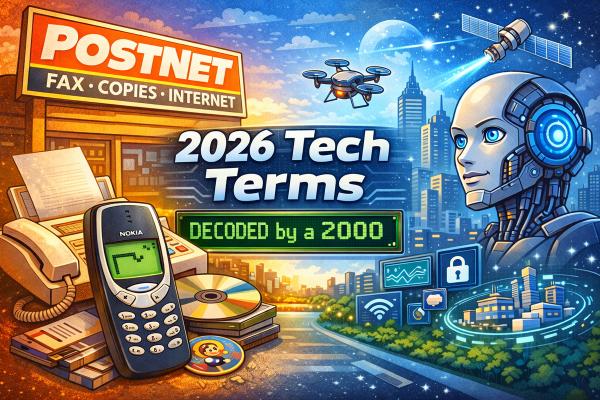
In the early 2000s, “high-tech” in South Africa meant sending a fax at PostNet, making a call from a blue-and-green Telkom tickey box by dropping coins or inserting a card, and waiting for M-Net Open Time to catch international shows. A “smart device” was your Nokia 3310, or “brick” phone, valued mostly for surviving a fall. Even connectivity itself was something you could see — from street payphones to telecom network containers, like the bright red community chat containers rolled out by Cell C, quietly powering communication long before the internet felt instant, invisible, and always-on.
Fast forward to 2026, and opening LinkedIn can feel like stepping into a completely different world. Back then, you could see the technology around you — payphones on street corners, network containers humming in the background, and phones that only handled calls and Snake. Now the infrastructure is invisible, the systems are smarter, and the language has evolved just as fast. Suddenly, everyone is talking about “AI executives,” agentic systems, multi-agent workflows, AI-native platforms, and AI-slop. But how much of it is truly new, and how much is just familiar ideas with a modern upgrade?
South Africa’s digital world, like the rest of the globe, seems futuristic. Still, behind all the buzzwords and new tools, the main ideas are actually simple.
I grew up as technology changed, and studying Data Science helped me understand how these systems work. At Tati Software, we believe technology should be practical and easy to understand, designed for real needs rather than just sounding impressive.
This blog gives straightforward explanations of the main tech terms you’ll hear in 2026.
1. Artificial Intelligence & Agentic Systems
Let’s start with the most talked-about topic: artificial intelligence and how it’s changing. For each term, I’ll explain what it means, how it’s different from the 2000s, and why it matters in everyday life.
Generative AI
2000s version: Imagine MXit, except the person on the other side can instantly write reports, design graphics, analyse data, and never needs to log off to do homework (or pretend to do so).
2026 version: Generative AI creates content like text, images, code, and insights, all based on data and prompts.
Why it matters: Businesses use AI to handle customer support in different languages, speed up admin work, and find insights, all without needing large teams.
Agentic AI
2000s version: A personal assistant who doesn’t just remind you; they actually complete the task for you.
2026 version: Agentic AI systems can plan, act, use tools, and complete multi-step tasks independently.
Why it matters: For growing SMEs, this reduces manual workload and allows teams to focus on strategy rather than repetitive tasks.
Multi-Agent Systems
2000s version: Imagine a BBM group chat with friends — each person has a role. One friend shares memes, another updates on schoolwork, and another keeps the mood light. The chat “runs” itself because everyone collaborates naturally.
2026 version: Multi-agent AI systems work the same way, with different digital agents handling parts of a workflow. One might write content, another review it, and another post or deploy it.
Why it matters: Large tasks can be automated efficiently, mimicking the teamwork you knew in your BBM group
AI -Native Platforms
This term means platforms are designed from the start with artificial intelligence at their core, not just added on later.
2000s version: Most platforms were simple, think of a basic website with a calculator plugin. The intelligence was bolted on, not built in.
2026 version: AI-native platforms have AI built in from the beginning, not added as an afterthought.
Why it matters: These platforms grow and work differently, making it easier to use AI smoothly.
RAG (Retrieval-Augmented Generation)
2000s version: Guessing the answer from a textbook that might be outdated.
2026 version: RAG ensures AI responses are based on verified, real data before providing a response.
Why it matters: This reduces mistakes, making AI more reliable and trustworthy, especially in industries with strict rules.
AI-Slop
Before we get too excited, here’s a newer term that shows the downside of fast AI growth: the mess that happens when there’s more quantity than quality.
2000s version: Remember spam emails and chain messages? Like those emails from a relative warning you’ll have bad luck if you don’t forward them to 15 people. Now imagine that, but multiplied by AI.
2026 version: AI-slop is the flood of low-quality AI content, like endless recycled TikTok trends, auto-generated captions, and copy-paste 'thought leader' posts.
Why it matters: Too much low-quality content can reduce the effectiveness of future AI and clutter digital spaces. That’s why good rules and quality checks are important.
2. Infrastructure & Cloud 3.0
Modern AI needs a strong foundation in cloud and infrastructure, which have changed significantly. Let’s look at how these basics have evolved and why they’re more important than ever.
Cloud 3.0
2000s version: Keeping files on a floppy disk because dial-up was slow.
2026 version: Cloud 3.0 is the smart backbone for AI, handling heavy computing and real-time processing.
Why it matters: The cloud now actively powers AI systems, not just stores data.
Compute
2000s version: Basic desktops often struggled to run Windows XP. If your computer survived a restart, you were basically a tech wizard.
2026 version: Compute is the raw processing power, like GPUs and special chips, needed to train AI models.
Why it matters: Compute is like the hidden currency of AI. Without it, models can’t train, grow, or work at all.
Geopatriation
This term refers to companies moving data to local servers to comply with new laws and meet higher privacy standards.
2000s version: Not really a term then; think storing personal files locally for safety.
2026 version:Companies now move data and cloud operations to local regions to comply with regulations. In South Africa, laws like the Protection of Personal Information Act (POPIA) are driving this shift, ensuring personal data is handled responsibly.
Why it matters: This helps companies follow the rules, protect privacy, and build trust.
3. Security & Governance
As technology advances, new risks emerge as well. Let’s look at how security and governance have changed since the 2000s, and why everyone should care, not just IT professionals.
Zero-Trust Security
2000s version: A security guard who checks your ID every single time, even if you just went to the bathroom and came back.
2026 version: No user or device is trusted by default; every access request must be verified.
Why it matters: This approach protects sensitive data amid rising cybercrime and increasingly strict regulatory environments.
Preemptive Cybersecurity
2000s version: Antivirus that only ran when you clicked “scan.”
2026 version: AI systems spot and stop threats before they cause harm.
Why it matters: Stopping problems before they happen is far more effective than fixing them later, making it key for today’s organisations.
Digital Provenance
2000s version: Keeping a paper trail for important documents, usually in a shoebox or under your mattress, next to your secret stash of chips.
2026 version: You can track where data comes from, how it’s used, and if it can be trusted in AI systems.
Why it matters: This keeps the data that AI uses accurate and trustworthy.
4. Emerging Intelligent Systems
Digital Twins
This emerging concept is transforming how we interact with everything from factories to cities, connecting the digital and physical worlds more than ever.
2000s version: Playing SimCity or The Sims, except the simulation is linked to the real world.
2026 version: A digital twin is a virtual copy of something real, like a factory, power grid, or delivery network.
Why it matters: Digital twins let you test changes, spot problems early, and improve performance, all without affecting the real world.
Edge Computing
2000s version: Saving files locally because the internet was slow.
2026 version: Data is processed near where it’s created, instead of sending everything to faraway cloud servers.
Why it matters: Edge computing means faster responses, better reliability, and stronger data privacy.
Final Thoughts
Looking back, the fast pace of tech change can feel overwhelming. But when we break down the terms, we see that many are based on ideas we already know. The future is nearer and more familiar than it looks.
Technology isn’t magic; it’s curiosity, supported by good systems, rules, and design.
2026 isn’t just about AI answering questions. It’s also about AI systems acting, working together, becoming part of our infrastructure, and being used responsibly.
From MXit to multi-agent systems, we’ve come a long way.
Once you understand the language, you’ll see that adapting to new technology is something you’ve always done, often without noticing. Every new wave builds on the last, and you’ve been part of that journey the whole time.